




I conducted an original research study as part of my Political Psychology course. Inspired by my summer internship with Raise Your Hand Texas, I explored how the framing of language influences public opinion on education policy. The project, titled Framing Education Policy: Do Words Really Matter?, examined the role of strategic word choice in shaping attitudes toward key issues such as school funding, teacher pay, pre-K accessibility, and school vouchers.
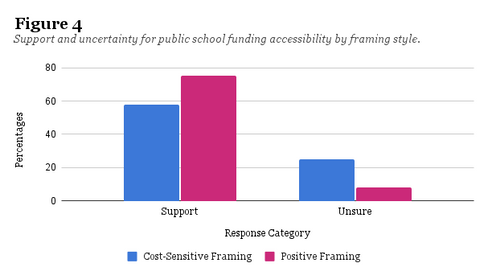
I developed a research question and hypothesis, designed a survey, and collected data from 807 respondents. The survey tested two framing styles: positive or benefit-focused language (e.g., “expanding opportunities”) and cost-sensitive language (e.g., “increasing taxes”), analyzing their impact on support levels for various policies. My findings revealed that positive framing consistently garnered higher support and lower uncertainty, particularly among independents and women, while cost-sensitive language led to higher levels of indecision.
The study offers insights for policymakers and advocates, emphasizing the importance of strategic communication in policy advocacy. I also identified areas for improvement in survey design, including reducing ambiguity and expanding sample diversity to enhance results. This project allowed me to apply concepts from political psychology, such as framing theory and decision-making processes, while working my research, data analysis, and academic writing skills. The findings provide a framework for effective messaging in public policy, particularly in education, and demonstrate the power of language in driving legislative and societal outcomes.